

Uncertainties, fears, but also the realization of a dream, or rather two: this is the story of Alessandra, who went from being a patient to becoming a researcher on antiphospholipid syndrome and the mother of two children.
Alessandra’s story began in 1998 when, at just 21 years old and actively involved in sports, she developed pain in her calf that doctors initially attributed to a “muscle strain.” However, the pain did not go away; instead, it worsened. “I competed in the long jump and I ran,” Alessandra recalls, “so they said it was surely due to that. But I had not suffered any injury, and I realized that this pain was different from the muscle or tendon pain I had experienced before. I underwent numerous medical tests, but no one could understand why I had this pain, which kept progressing until I was forced to use crutches to get to university,” where she was studying Pharmaceutical Chemistry.
After some weeks, her leg became so swollen that she was taken to the emergency room, where she was finally diagnosed with deep vein thrombosis (DVT). Fear and confusion initially took over. Alessandra, now “a patient,” was hospitalized and suddenly lost her independence.In fact, contrary to what is recommended today (early mobilization and walking), she was subjected to complete bed rest during her ten-day hospital stay.
At the time of her diagnosis, much of the knowledge surrounding venous thromboembolism, and even more so antiphospholipid syndrome (APS), was still unclear. Initial tests did not reveal any coagulation abnormalities. Because she was receiving estrogen-progestin therapy, the cause of the thrombotic event was attributed to the hormonal treatment, and anticoagulant therapy was discontinued after three months.
However, a recurrence of venous thrombosis only one month after stopping treatment revealed that something more serious was hidden beneath the surface. “I was hospitalized again,” Alessandra explains, “and once again immobilized. I was terrified, but fortunately in Padua I met excellent doctors who identified the presence of triple-positive antiphospholipid antibody syndrome, the most severe form.” After the diagnosis came another concerning message: “You will need to take Coumadin for the rest of your life,” and, most of all, “no more sports.” It was a devastating sentence because, as Alessandra explains, “sports were my outlet.” “For two or three years I actually stopped. Then, fortunately, I started swimming, and that is where I met my husband, who was my coach!”.
Today it is widely recognized that returning to sports, gradually and while avoiding activities with a high risk of trauma if still on anticoagulant therapy, is not only possible but recommended, provided it is done in consultation with one’s physician and with appropriate precautions, such as wearing a helmet when cycling.
Meanwhile, Alessandra completed her degree in Pharmaceutical Chemistry. “I decided to write my thesis on this disease because at the time almost nothing was known about it. There was a great deal of confusion, and that situation had caused me a lot of suffering,” she explains. “I wanted to help people avoid going through the same painful journey I had faced. I wanted to be useful to others in the way I could, through my degree.”
Alessandra succeeded in her goal. Over the past twenty years, she has collaborated with leading international research groups working on antiphospholipid antibody syndrome and has co-authored numerous scientific publications. This path enabled her to develop unique expertise both as a researcher and as a patient, helping her make a choice that was as courageous as it was aware: motherhood.
Before reaching that point, however, she had to overcome another enormous obstacle. A mole that everyone else underestimated, but not her, turned out to be melanoma. Surgery and treatments followed, as well as five more years of waiting. Then, finally, came the long-desired pregnancy, which for someone with APS is a true test.
Because of the high risk of miscarriage and thrombosis, she required therapeutic doses of low-molecular-weight heparin throughout pregnancy, consisting of two injections a day. Due to the severity of her condition, this was combined with weekly plasmapheresis, a procedure that selectively removes pathological antibodies from the plasma.
A true adventure that ended wonderfully… with the birth of a baby boy!
“When I left the hospital with my baby, I promised him I would give him a little brother or sister,” the researcher says, but when a new pregnancy began two years later, a team of doctors advised her to terminate it.
“By then, however, I had progressed with my research, had consulted international experts, and I was convinced, from a scientific point of view as well, that I could do it.”
And indeed, under the care of specialists at the Brescia Hospital and with the continuous support of Professor Pengo, her second pregnancy was also successful. “I call my children my two miracles,” says Alessandra, her voice breaking with emotion and joy at being able to appreciate every day the happiness found in life’s small moments, moments that “people without health problems often miss amid the chaos and rush of everyday life.“
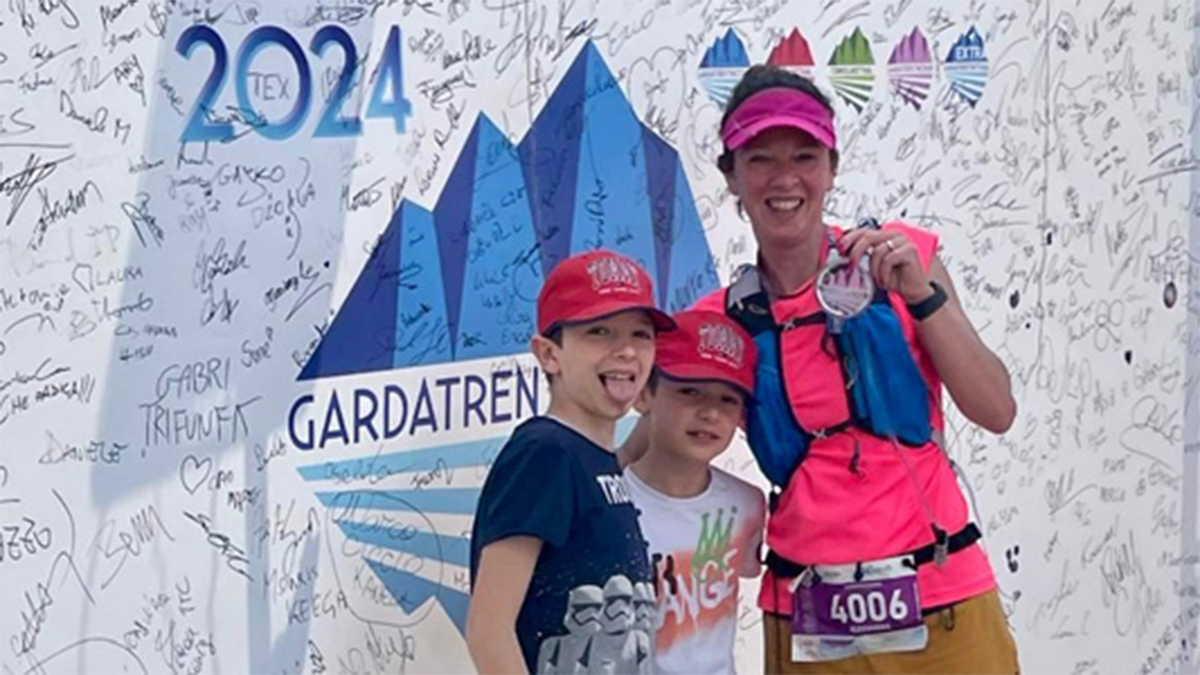
Today, in addition to swimming, Alessandra has returned to running. She competes in numerous events and concludes: “They told me never to stop doing sports because it has been my salvation.“
If you wish, you can comment on this article. Comments will be moderated by the Editorial Team with the kind collaboration of Alessandra.
If you would like to share your own experience, you can write to redazione@anticoagulazione.it