

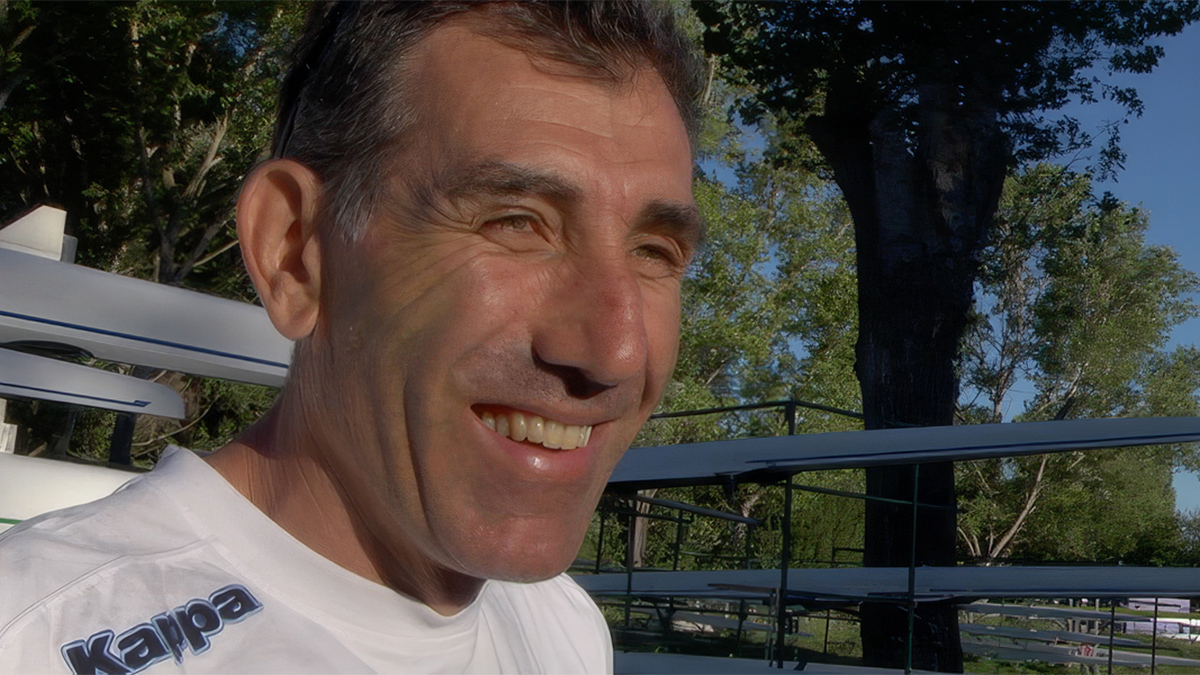
On World Thrombosis Day, October 13th, we interviewed Agostino Abbagnale, a three-time Olympic rowing gold medalist despite being afflicted with deep vein thrombosis from a young age, requiring chronic anticoagulant therapy.
“It’s a good time, I’m resting. We just returned from the World Championship qualifying competitions.” And how did it go? “Good,” replied Agostino Abbagnale, now coach of the Italian team, always willing to share his story “if it can help others.” And his story can certainly help those who, disoriented and frightened by a diagnosis of deep vein thrombosis, find themselves dealing with everyday choices.
Let’s retrace together the milestones of a long journey that began with what for many (perhaps all) is a finish line: the gold medal for rowing at the 1988 Seoul Olympics.“I was 22 years old, a very young athlete coming off an Olympic victory and thinking I could continue this activity for several more years; instead, I found myself dealing with these problems and having to stop competitive sports.”In fact, after a workout,“I felt a discomfort in my calf; I thought it was the classic muscle pain due to excessive effort and didn’t pay much attention to it. After a few days, seeing that the pain was getting worse, on the advice of my coach, who was also a doctor, I started undergoing tests. However, back then (it was 1988, ed.), I encountered major difficulties in reaching a diagnosis and a therapy, difficulties compounded by the compromise to my training and the worry about upcoming races.”
Eventually, the diagnosis of deep vein thrombosis arrives, and with it the therapy, but after a few months the problem reappears, this time more severely. Abbagnale is hospitalized at the Hospital of Pavia for a recurrence of deep vein thrombosis, and from that moment on, partly due to the discovery of a hereditary thrombophilic alteration (protein C deficiency), he begins chronic anticoagulant therapy with warfarin. To the initial worries related to managing the therapy (which requires periodic blood checks for the INR) are added those, much more important to him, caused by the stop imposed by the Italian Olimpic Commission (CONI). In fact, “at the time there was no kind of research that could support competitive sports activity while on anticoagulant therapy, so I had to stop for six years.”
“In the end, though, Coumadin brought me luck”—Abbagnale joked, referring to the fact that he went on to win two more Olympic golds (at Atlanta in 1996 and Sydney in 2000, ed.). But it wasn’t easy. “After the initial phases, where I had to face this bad news, I independently decided to continue playing sports, even if not competitively. It was the thing I liked to do and I kept doing it.” Fortunately, “the doctor who followed me through all these phases, Dr. Piovella of Pavia, always encouraged me to live a normal life and continue sports activity, but above all he managed, by presenting the scientific evidence produced in subsequent years, to get the CONI medical commission to reopen and grant me authorization to compete”—Abbagnale tells us with a hint of emotion.
“Fortunately, the thrombosis itself left me with only some discomfort in my leg and the ‘annoyance’ of having to wear an elastic stocking, even during training, but we managed to get past that too”—jokes the Olympic champion. “Since last year we decided to switch to the new anticoagulant drugs (DOACs, ed.), with which I actually feel more relaxed, not only because I no longer have to do tests (for the INR, ed.) but also because I don’t have to pay so much attention to food. Let’s say there has definitely been an improvement in the quality of life”—Agostino concluded, but not before telling us that “often kids call me, even athletes, with situations similar to mine who ask me for information regarding this type of problem,” and the message can only be one of encouragement.
Watch the story, told for us by Agostino Abbagnale in 2017.”